Following a presentation on congregational revitalization, a pastor leaned 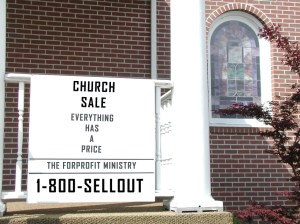 back in his chair and said, “Any church that isn’t growing should be closed, so that we can launch a healthy one in its place. Revitalization doesn’t work. You can’t raise a church from the dead.” Now, I find this an interesting perspective from a person who worships a Savior who came back from the dead, but that’s neither here nor there. What I want to focus on three assumptions in his comment:
- if a church isn’t “growing” (in his case, he meant numerically) it should be shut down
- new churches are healthier than existing churches
- revitalization doesn’t work
Numeric decline as an indicator of health — there is a simple, but flawed logic here: bigger is better, smaller is not. However, the underlying assumption is that growth is a sign of health while decline is a sign of sickness. Drawing a parallel with the human organism, we view growth as a good sign… but only so much. In adolescence, getting taller, heavier, and more muscular were all indicators of vitality. However, in maturity, I have continued to grow, but not in good ways. Obesity is growth, but not health. The tumor I had removed was a form of growth, but not health. The hair that now playfully peeks from my ears and nose indicate growth, but not robust health. No, at this point in my life it is not growth but reduction that will lead to greater health. Less is more when it comes to personal health, and the same has been found to be true in church life as well. Many of our healthiest congregations are those that “trimmed the fat,” that increased the demands and expectations of leadership, and eliminated inactive and non-engaged members. When I conducted the research for the Vital Signs study, I was constantly amazed at the number of healthy churches that had to go through a period of numeric decline and financial hardship to get healthy. Just as the human organism often has to engage in disciplines of diet and exercise to get healthy, so the path to congregational vitality requires a “downsizing.”
This is not to say, I repeat, NOT to say, that numeric decline is a sign of health. It isn’t (in and of itself), but growth by itself is not a reliable indicator of health. We have a number of impressively increasing congregations that are producing nothing more than a higher number of passive, consumeristic, disengaged believers. There are churches that should be helped to move toward closure — no argument there. But the blanket assumption that numeric decline is a primary indicator of viability is bogus.
New churches are healthier than existing churches — oh, come on. I hear all the glowing rhetoric and am appalled at the lack of honesty. This is a classic example of comparing success to failure — looking at the exceptional successes and measuring them against exceptional failures. Not cool. Comparisons need to be success against success, failure against failure. In my study of vital congregations, twice as many healthy churches come from rocky histories as from new launches. Turn-around churches are deeply impressive and much more prevalent than successful “new” launches. Any thorough, unbiased, agenda-free analysis of the data will prove this out. But there is very little of that analysis around. We LOVE the idea of new churches, and we are absolutely addicted to the stories of mega-church success. Good luck with that.
And new churches do have some definite advantages. A new church can write its own future. But time after time a new church has to face significant decisions about integrity versus appearances. A new church has special pressure to “succeed,” and success is measured in numbers of participants. As one pastor of a fast-growing UM church shared with me, “I will not do anything that might make a person question whether they made a mistake joining my church. We do everything possible to keep people comfortable.” This may be an effective strategy to keep people happy. Is it an effective strategy for making disciples?
For both new and old congregations (in terms of existence, not age) the critical elements are vision and leadership. Being selective in using only biased information doesn’t make something true. Success depends on more than a new building in a new location with new leadership. Many of our desperately struggling congregations are less than twenty years old. If we don’t know how to make existing congregations effective, it is highly unlikely we will know how to make new churches effective — and we simply don’t need more ineffective churches.
Revitalization doesn’t work — based on what? Looking at dysfunctional small churches lacking leadership, resources and vision? Okay, I’m cool with that. There are a lot of those kinds of churches out there. But some of the greatest success stories we have in our United Methodist system are churches that were stuck, bogged down, directionless, and completely demoralized that experienced nothing short of resurrection. How did they do it? Once again, leadership and vision. A majority got to the place where they had nothing left to lose, so they asked hard questions about meaning, purpose, and potential and they got serious about discipleship. They raised the bar. They raised, rather than lowered, expectations. They caught a vision for something better than they ever had before. They experienced vitality through sacrifice, commitment and service.
Revitalization is not automatic, and it won’t happen everywhere. But there is potential for revitalization in just about every United Methodist congregation that finds itself struggling or underperforming. What is needed is a visionary strategy and commitment. What is essential is the courage to make hard and often unpopular decisions. But it can be done. Those who claim that revitalization is a waste of time are lazy and dishonest. They are enamored by the idea of new, bright, shiny churches that look like the ones on the glossy covers of church growth books and fancy websites. They are not paying attention to the best research into disciple-making and spiritual transformation.
The current reality — the now — is challenging and often discouraging. But the now is not all there is. We have a lot of control over our destiny — our future. The not yet is — as yet — unformed. We can create just about any future we choose — but it will take hard work, commitment, and dedication. What will not help us is to commit to an irrational and unfeasible dream of what we would like to see instead of pragmatically examining what ought to be. Much of what we want is not possible, and a lot of what we have castigated as impossible is not only possible, but likely to yield the greatest results for disciple-making and social transformation.
We need new faith communities. But we cannot give up on the viable centers for renewal and transformation. We need new opportunities. But many of them exist in contexts that we are all too willing to give up on. We need growth — but of substance not just size. We need to see the full range of possibilities and not sell out to the path of least resistance.


 FaithQuest Revisited
Leave a comment