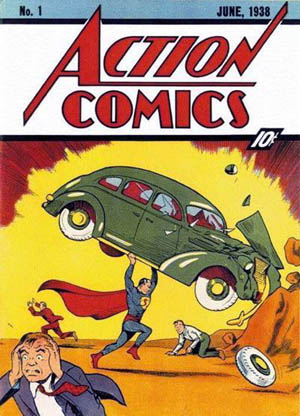
 I don’t consider myself an old fogy or a prude, but I’m getting fed up with what’s happening to our superheroes. Last year I eagerly anticipated the Watchmen movie, yet I left it disgusted at the glorification of brutality and the gratuitous violence that all but obscured the story. Now, we have Kick-Ass, a clever concept gone sour through violence, foul language from young children, and a moral ambiguity worthy of ancient Rome or most college frat parties. Writers, illustrators, script-writers, and directors defend their “product” by saying they are a more accurate representation of our times. But why do fantasy/escape movies and comics have to represent the worst in us? For decades the comic superhero offered a counter-cultural, counter-reality vision for what could be. Heroes made a commitment not to kill, not to revel in their violence (until Wolverine), and they offered hope (truth, justice and the American way; with great power comes great responsibility, etc.). Their fundamental goodness counterbalanced the use of violence to solve problems. Surely there have always been contradictions and ambiguities — for a while in the 1950s, a crusade to wipe out any and all comic violence almost did to Superman what Kryptonite has never been able to accomplish.
We need heroes. Ideally, we would learn to focus on real heroes — firemen and paramedics and relief workers — and seek inspiration from real-life examples of heroism, sacrifice and dedication. Instead, we turn our attention to performers and sports stars who often prove all too human and less-than-stellar role models. Fiction — even in its base form of “graphic novel” — offers wonderful opportunity to present metaphors for character, positive values, and noble aspirations. And in comics, such characters aren’t hard to find.
We don’t need to create “Christian” alternatives. (Please don’t think I want to see some Pollyanna “Spirit Squad” — Love Lass, Joy Boy, Peace Keeper, Professor Patience, Captain Kindness, Generosity Girl, Faithfulness Man, Gentleness Giant and the Control Freak — nine heroes that mix to produce a powerful fruit salad of justice and righteousness! Let’s not go there…) But we can turn to these fictional heroes to find out what dedication, perseverance, sacrifice, and championing the underdog look like. We can ask what values drive such fictional characters. There are many great discussion starters in a Spider-Man comic, film or cartoon.
But there is virtually nothing redeeming in films that glorify brutal violence or language in the mouth of a ten-year old girl who would make most dock-workers blush. It’s sad to see the cynicism and hopelessness of disaffected and nihilistic malcontents displace a more positive vision. I acknowledge there is a market for harder-edged, more “mature” comics, but the lines have now been blurred. Watchmen was never intended for a young audience when it came out as a graphic novel. But as a film, it attracted a new, young generation (and many a shocked and surprised parent thought they were heading for another Spider-Man/Batman thrill-ride, not butchery, brutality, and bad language. Kick-Ass is an even less pleasant surprise, and it casts a shadow over those titles that still attempt to communicate a more positive message.
It’s official. I am now one of those annoying adults that begin sentences with “when I was a boy…” When I was a boy, heroes were heroes. Superman, Batman, Green Lantern, Wonder Woman, the Flash, and Martian Manhunter actually earned the title “Justice League.” There was never a concern that Iron Man, Captain America, Thor, Ant Man and the Wasp would “go postal” in their quest to avenge. (Yes, yes, Hulk was a loose cannon, and would smash with glee — and there was no blood and the smashee sat up with stars circling his head wondering what hit him). Spider-Man was the bane of every form of turpitude. Superman was the epitome of the good guy. When I was a boy, it was crystal clear who the good guys were, and who were the villains.
We need metaphors and characters that help us choose to be good. We need stories that promote what is right and decent, where good does triumph, and where evil is never the right choice. We have such metaphors and characters in the church, and we have such wonderful opportunities to bridge the behaviors and values of our faith — truth, justice, mercy, grace, self-control, love, sacrifice, generosity and kindness — to the cultural icons of our day. I hope we can recover a vision for goodness… and let our heroes be heroes once again.


 FaithQuest Revisited
Leave a comment