Teachers gonna’ teach, I guess. Believe it or not, I am at the President Elect training for Rotary Interntional in Illinois this weekend. Yes, I will be the president of Oregon (WI) Rotary from July 2024 through June 2025. Go figure. However, I was in a breakout session this morning when someone asked why right leaning Republicans seemed to be gaining influence and power while Democrats – who aren’t facing nearly the internal divisions and struggles – seem clueless when it comes to gaining support. I held my tongue until someone asked me directly, then I shared that I had a theory. As I talked, our group of five became ten, then twenty, until I was holding court with about thirty-five people listening to my idea. It is a very weird sensation to just be talking and then it turns into a presentation.
This is not a new theory for me, and anyone who attended my visioning/strategic planning trainings over the past thirty years have seen a variation of this. It took all of five minutes to retitle the slide and make it about politics instead of planning. The theory is simply this: in every situation where a group is involved, there is an approximate bell curve. At one end are about 5% who are actively calling for change, about 15% ready to change if there is a good reason, 30% who will go along with change once they see the benefits, 30% who are initially reluctant to change and are perfectly happy with the status quo, 15% who resist the change, and 5% who oppose the change and even would like to undo many of the other changes they have had to endure.
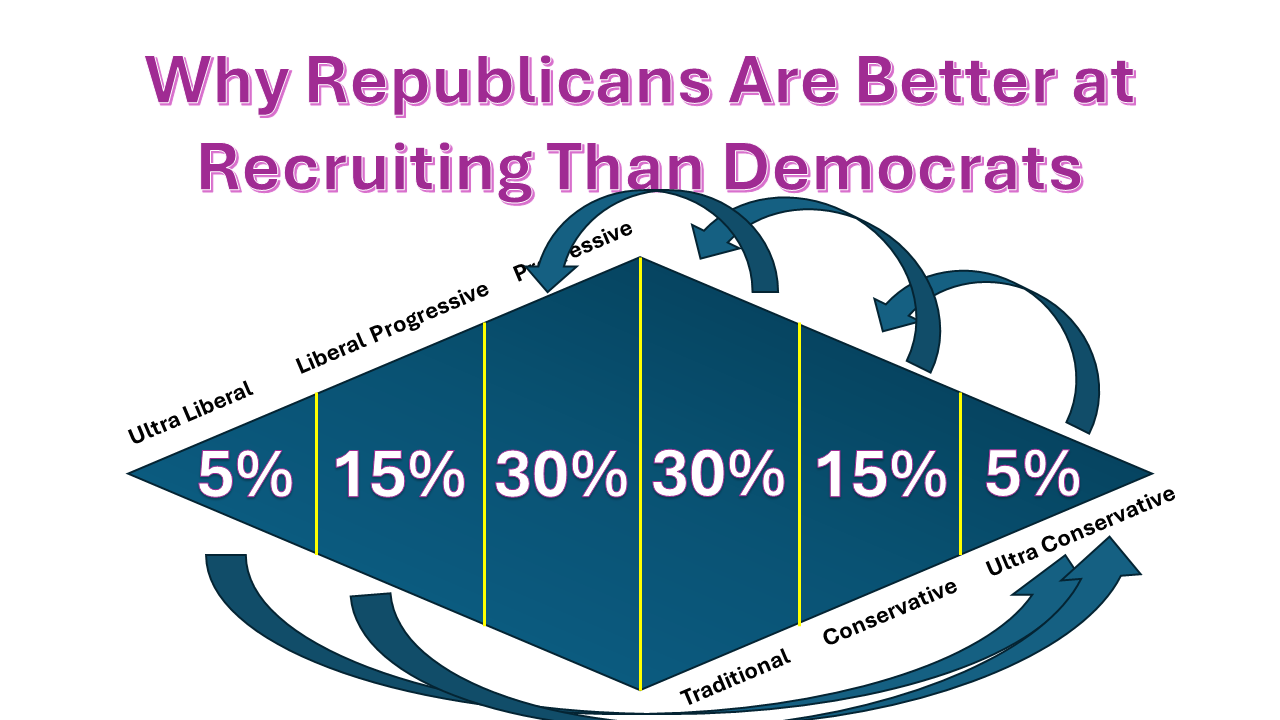
What often happens in such situations is a polarization between the two extremes, in the political arena, the “ultras” begin a huge debate over just about anything – immigration, race, sexual identity, abortion – over-simplifying and reducing complex issues into simplistic binaries (good/bad, right/wrong, holy/evil). In our current social climate, ultra-liberals to liberal-progressives establish immovable positions and take firm stands on their principles. But the conservative side of the spectrum learned three valuable lessons that liberal-progressives haven’t caught onto yet.
In between the extremes, a total of 10% lie close allies, another 15% on each side. These are easy converts. But instead of creating a tug of war with the other extreme, conservatives focus their attention on the middle 60% where there is fertile soil for influence, manipulation, and recruitment. 20% against 20% is the irresistible force meeting the immovable object, but 50-65-80% against 20%, the odds just get better and better. First lesson.
And how do ultra-conservatives keep the liberal-progressives from following suit? They lob ridiculous, outrageous, irresistible conspiracies, positions, and proposals at the liberals to get them all “het-up” and irrational. The Democrats get reactive while the Republicans stay responsive. Second lesson.
What is the fuel that persuades one end and alienates the other? Fear. Immigrants are rapists and murderers, and at the very least they take our jobs. Liberals are trying to destroy America. Democrats are fascists. Homosexuals (note, not LGBTQIA+) are pedophiles and they want YOUR children. Biden is senile. American education is undermining our Christian nation’s identity. It does not matter if these statements are true or not. If they raise doubts, heighten anxiety, increase fear, and undermine trust, they till and fertilize the soil for rapid growth and spread. Third lesson.
I had about 50-50 conservatives and progressives in the small group I spoke with, and there was quite a bit of agreement about the process, if not the approach. One Trump supporter openly admitted that his guy was a master manipulator and could be a poster child for my theory. He didn’t like what I was saying about whether the things said were true or not, but he couldn’t argue that Republicans work the process much better than the Democrats. And the Democrats and Independents in the room readily agreed that the conservatives are shaping the whole conversation, and that Democrats react rather than respond. I was asked by a half-dozen people if I was available to come out and talk to their club as the elections loom closer. I’m not sure what chord this theory struck with folks, but it really engaged a room full of people in a very respectful and spirited conversation. There is nothing new or profound in this analysis and it doesn’t take much to see how it is playing out in our politics and culture at the moment.
Oh, yeah, and it was just me thinking out loud and sharing my opinion. I could be wrong. It’s happened before and it will happen many times more in the future. But it was an interesting catalytic moment following a session on addressing conflict and being inclusive that I just thought I would share.

 FaithQuest Revisited
Leave a comment