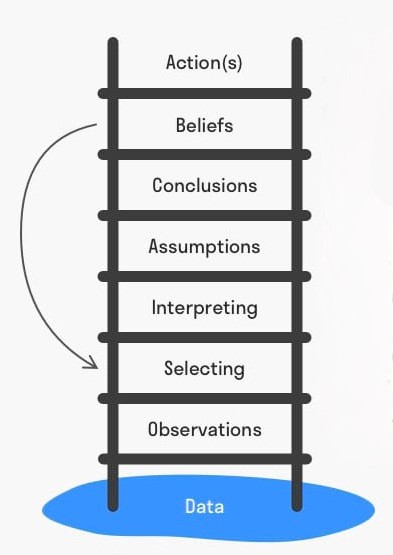
What are the implications of the Ladder of Inference for communication, learning, cooperation, and collaboration? If the ladder is subverted by our beliefs as filters, how in the world do we set our core beliefs aside to hear more broadly, see more clearly, trade our certainty for a healthy curiosity, and establish a protocol for truthful, meaningful, redemptive, and restorative relationships?
Let’s look at the ladder as an asset rather than a liability. How can we use this conceptual frame to improve relationships rather than allow them harm? Offering some simple guidelines to each step up the ladder can be helpful, but the most essential decision to make before ascending the first rung is to fact check and verify at each new level. Don’t take anything at face value, but confirm and correct. This will save us a world of hurt, frustration, and confusion as we go.
Let’s use “the big, beautiful bill” as our thought exercise. How might a healthy application of the Ladder of Inference help us better understand this current cultural complexity.
Data – the bill is the bill. It must be read. It must be absorbed. It must be understood. It must be clear. No one should vote or debate on this bill who has not mostly comprehended the scope and potential impacts it presents.
Observation – what are people saying about the bill? What is being lifted up as good, healthy, positive, and what is named as problematic, concerning, unacceptable, or harmful. Give opportunity for the broadest range of observations, with the least amount of value judgment or debate. Just share together what you see/feel as you digest the “bbb.”
Selecting – what about the “bbb” is worth addressing? What questions are raised? What further information is needed? Whose opinions and perspectives carry the greatest weight? Where will we give our greatest time and energy to bring about the greatest good for the greatest number of people? The “what” we will focus on is important. Here is a caution: If our core beliefs and values become filters at this point, it will definitely color everything moving forward!
Interpreting – what are the most likely, concrete results of each aspect of the “bbb”? No work is completely good or completely bad – there is a spectrum. The pieces are as important as the whole, but the support of the whole should depend on the proposal being structured on the best possible data and information, critical observation, and objective selection. What impact – good, bad, positive, negative, beautiful, ugly – will our decision have? Ultimately, will more good be done than damage, or more damage done than good?
This reveals to us our assumptions, and many, many assumptions were made during the adoption process of the “bbb.” Does it favor the rich? Does it punish the poor? Does it save us money? Will it cost us more? Will it help the economy or hurt it? Will it do more good for more people or less? Will it make us safer? Will we be better educated, employed, engaged, environmentally healthy, economically secure, and emotionally supported? Will it make it easier to get reelected or harder? Does it reflect and affirm the core values of our Constitution, Bill of Rights, Declaration of Independence, and our civil, state and federal laws? While we cannot know for sure all the actual implications, we cannot help but assume the good, the bad, and the ugly.
From here, conclusions can and will be drawn. This is where each individual makes the decisions that will confirm or contest their beliefs moving forward to action. If I believe the poor should do more for themselves, that immigrants are an evil threat, that our economy is strongest when the richest among us get richer, that climate change and the threats to our environment are negligible, that what happens in the next three months is more important than what happens thirty years from now, that diversity, equity, and inclusion are harming our relationships, and that education, health care, providing support for veterans and those with disabilities, are privileges rather than rights, then I will vote one way. If I want to feed the hungry, house the homeless, reform law enforcement and incarceration, care for the refugees and asylum seekers, are concerned with the big picture in both space (globally) and time (for the foreseeable future), believe health care is a human right, and believe that education, employment, economy, environment, and international community are keys to a stable world, I will vote the opposite way. Regardless, the vote will be based on the very best and healthiest consensus of the body, based on good information, critical and integral assessment, multiple and valid observations and priority selections, yielding a variety of assumptions leading to conclusions that confirm our conform our beliefs. Once we believe we are making the right decision, we will act – vote yay or nay.
I use this illustration to show that without a careful and intentional attention to the integrity of the ladder, there are multiple opportunities to leap from the ladder – due to poor data, bias, prejudice, incomplete information or partial observations, prior assumptions, misinformation, peer pressure, political pressure, public pressure, etc. By understanding the pitfalls we are better equipped to avoid them, and use what we have learned to make better decisions and develop greater need for and value of consensus.
The next post will wrap this up with some suggested strategies to avoid the pitfalls and maximize the benefit as we address the “s” in PARIS (Presentation, Application, Reflection, Implications, Strategy). See ya’.
 FaithQuest Revisited
Leave a comment