One of my most popular early posts (2009) was entitled Theology of Worship? In it I talked about some research I had done, and when we moved this year, I uncovered a whole notebook of interviews and survey results that went along with that research. I was fascinated with many of the notes and decided to return to the topic and share more of the insights.
The primary question I asked over 270 pastors and hundreds of lay people was: What is your theology of worship? The majority of people responded with, “I don’t understand the question. What do you mean?” which speaks volumes in and of itself, but my all-time favorite answer was from a preacher in Alabama: “Theology is what we believe about God. What does that have to do with worship?” That, in a nutshell, is the problem. Too many of our church leaders don’t have a clear vision or understanding of what God has to do with worship and what worship has to do with God. It is an indication of the general understanding of United Methodists about the experience of worship.
I offered interviewees the following: Is worship primarily a) about God for our benefit, b) about us for God’s benefit, c) about us for our own benefit, or d) about God for God’s benefit? Most folks laughed out loud at d), but 62% chose b), 21% chose c), and 20% chose a). Biblically and traditionally, a) is the intention and purpose of worship, however culturally and currently worship is about us over God at a 4-1 rate. What does this mean? The worship of God is about God, but God doesn’t need our worship. We need to worship God. And worship helps us focus on God, understand God and God’s will better, and is our opportunity to offer thanks and praise. It isn’t intended as education or learning, though that is what we have allowed it to become. It isn’t therapy, though, again, we use it as such. It isn’t about musical tastes or preferences, how we dress, and it isn’t meant to be passive. Once a congregation becomes an audience, worship ceases to be about God. However, overwhelmingly, people who provide worship and people who attend worship say they do it for themselves rather than God. In the last church I served, I was very intentional to talk to people who chose to leave our fellowship – either to join another or to quit entirely. These three statements pretty well define why people didn’t continue in the worship I facilitated. “Every week you challenge us to be God’s love to others, but I come to church to experience God’s love for myself.” “I feel guilty after worship because I feel like I am not doing God’s will. What about me? I need comfort and inspiration, not guilt.” “I come to worship to escape. I am tired, frustrated, anxious, and always doing, doing, doing. I don’t want to talk to others, have to recite anything. I actually come for the music.” This is worship about us, not God, not simply for our benefit, but fundamentally grounded in our needs, our desires, our preferences, and our expectations. None of this is unimportant, but it is not worship.
I also offered the following question: Is worship basically the end of the week that has been or a launch to the week to come? Most wanted to say “both,” but I didn’t allow this option – I made it a forced choice question. A small majority of the pastors and preachers chose “end of the week that was,” while a large majority of laity chose “a launch to the week to come.” Historically, when worship was focused primarily on God and the purpose was to offer thanks and praise, worship was seen as crossing the finish line for that which came before – an ending rather than a beginning. As worship became designed more and more about us for our own benefit, it became the launch of the week to come. Many people referred to worship as “fueling up” or “preparing” or “getting encouragement or inspiration.” Again, all important, but traditionally the role of spiritual formation in groups through study, prayer, and fellowship, resulting in service, mercy, and compassion. After engaging in tangible discipleship and stewardship, people gathered together to celebrate, give thanks, share in communion and a common meal – a “well done good and faithful servant” experience.
There was a very strong correlation between worship about God for our benefit and worship as the end of the week that was and those who saw worship fundamentally about us and worship as the launch to a new week.
I asked people to place in order of importance: prayer, hymns/music, reading of scripture, preaching, communion, joys and concerns, and the offering. Just note the differences in the two columns:
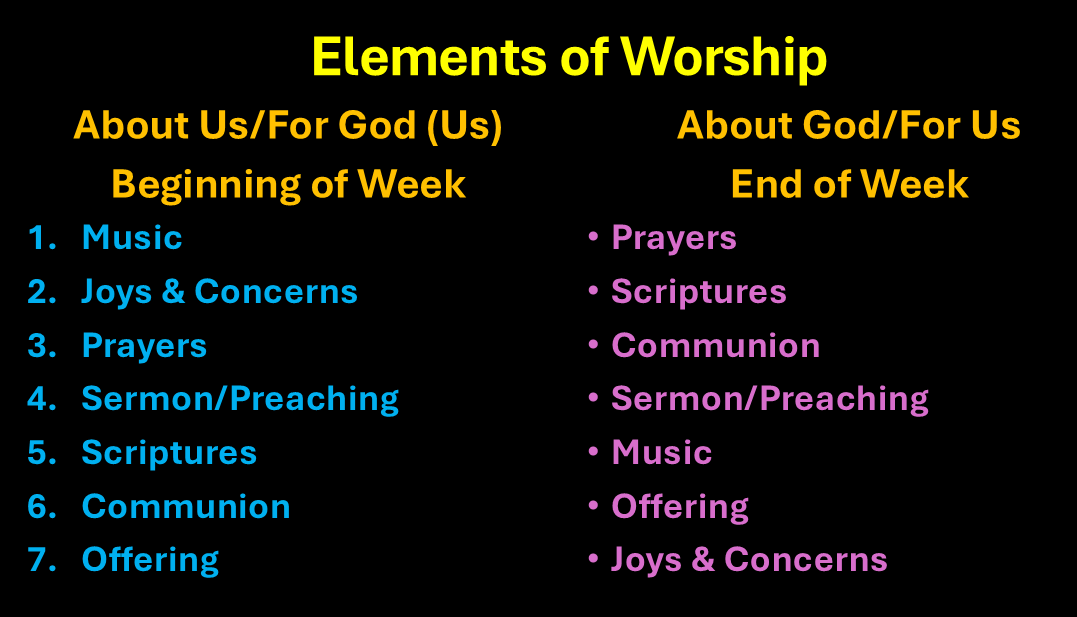
Pastor/preachers were a little distressed to find out that their messages were not in the top three on either list. Another correlation that emerged was about the importance of style of worship. When people feel that worship is essentially about them, style of music, formality, comfort, and focus (inspiration vs. challenge, encouragement vs. commitment, blessings vs. responsibilities) determined whether or not they would attend or stay connected to a community of faith. Where the purpose and focus of worship was God, worship style was essentially irrelevant. As long as God is central, type of music, formality, and comfort matter very little. In these situations, challenge, commitment, and responsibility are expected.
These correlations aligned with one other significant finding. Congregations where the essence of worship was personal and geared toward us were essentially inwardly focused. Communities of faith with the worship focus on God tended to be outwardly focused, more interested in service, outreach, and engaged in social justice ministry.
Do we need inspiration, encouragement, and guidance? Most certainly, and this should be the spiritual formation and Christian education goal of every community of faith. Does good worship inspire, encourage, and guide? Absolutely, but because it benefits us in our discernment, discovery, and development of our opportunities to serve God and fulfill God’s will as the body of Christ, not because it is designed to satisfy, comfort, and please us.
Our cultural values and societal priorities lead many people to seek entertainment over engagement, encouragement over expectation, and passivity over participation. In over 70% of the congregations I visited, worship was essentially performed for an audience. Beyond singing and clapping, members of the congregation did little else.
I am not going to draw conclusions or say one form of worship is preferable to any other but will allow the research to speak for itself. The value of worship seems rooted in what we are looking for, what we feel we need, and how we are taught to understand the worship of God. The worship wars of the late 20th century (traditional vs. contemporary, high church vs. low church, formal vs. informal, organ vs. praise band, blended styles <my definition of blended worship is worship where everyone has to sit through something they hate in order to get to something they like>, robes & suits vs. jeans & t-shirts) shifted more and more focus off of God and more and more onto our own preferences, tastes, and desires, accelerating in part the decline of active participation and attendance in mainline churches.
 FaithQuest Revisited
Leave a comment