A Different Set of Eyes: C.G. Jung – Archetypes and the Collective Unconscious
The tsunami of paradigm shifting thought that emerged between the writings of Sigmund Freud and C. G. Jung has had a universal impact on the way we view humanity. Confronting the hardwiring of binary thinking still prevalent after the enlightenment, Freud and especially Jung recognized the complexity, elegance, and interrelatedness of the human psyche, physiology, cognitive ability, and spirituality. I will admit, Jung can be a bit of a slog, and he likes to repeat himself with run-on sentences more than the Apostle Paul, but so much of what he says indicates a view of reality from a different set of eyes. Who we are, how we got this way, how we define purpose and meaning, what we value and what values guide us are all addressed in Jung’s writings on archetypes and the collective unconscious. If you gain nothing more than a wider appreciation of world religions and the underlying power of personality on spiritual identity, this book is a valuable and provocative read. It has the power to inspire growth and change in the way you understand yourself, others, God, the world, politics, business, family, and religion. How many books can do that?
The Best Book You Will (Probably) Never Read: Jewish Magic Before the Rise of Kabbalah by Yuval Harari

This book is dense. It is footnote heavy. It is redundant. It is an excellent 50 page research paper squeezed into 600 pages. So why am I offering this review? Because this is one of the best books I have read in a long time, and it would be so valuable if every Christian preacher would take the time and make the effort to read it.
Here’s the sublime and elegant value of this thoroughly researched and extensively documented scholarly work: it makes crystal clear three vitally important truths:
First, modern/post-modern Western readers of Jewish and Christian pre-enlightenment have virtually no clue what they are actually looking at. Context, history, geography, values, culture, and cognitive capacity are so dramatically different from what we have experienced since the dawn of the Age of Reason that we too often impose our worldview and perspectives on primitive, premodern, and archaic faith traditions. We may claim commonality, but Judaism and Christianity before the enlightenment bear little resemblance to what we practice today.
Second, rational/transrational filters do serious damage to acknowledgement and validation of mythic/magic/atavistic aspects of Judaism and Christianity that were central features of these ancient belief systems that we all too easily dismiss, ignore, or mock today.
Third, mainline Christianity and many reformed aspects of the Jewish faith disdain solid research, study, scholarship, and academic rigors choosing modern conceits of psychology, sociology, and anthropology presented in popular forms that imply that we know more about earlier peoples than they knew about themselves. This causes us to look for feminism, racism, classism, globalism, Socialism/Communism/Fascism, environmental concerns, and guidance for modern warfare, wealth inequality, medicine, and technology in sources that have absolutely nothing to do with any of these things. Can we extrapolate ethics and morality that shape our understanding of justice, peace, and mercy from these writings? Most certainly, as long as we don’t buy into the idea that Jesus is telling us how we should be dealing with guns, vaccines, AI, smartphones, online gambling, fast food, airplanes, organ transplants, cloning, or the Super Bowl half-time show. For that, we must “work out our own salvation with fear and trembling.” But understand that while we are obsessed with partisan politics and global relationships, our Jewish and Christian forebears were more concerned with learning incantations and adjurations that would make spiritual forces do their will, generally for the betterment of all concerned (though, of course, humans being humans, we also wanted to learn curses that would make those suffer with whom we disagreed…).
The bottom line is that too many Christian leaders – pastors, preachers, teachers, professors, researchers, and evangelists – don’t really understand the roots and evolutionary development of what we believe today. Magic, sorcery, miracles, control of forces and the humors (fluids) of the body, ritual sacrifice, demonology, witchcraft, divination, and mystic arts birthed our Hebrew and Christian traditions. We will never fully realize the power and potential of our faith today without understanding what they meant before reason, rational inquiry, and scientific methodology (all gifts to us from God) changed our understanding of reality and creation.
Why Shouldn’t I Read These Books?
Our country is going through a traumatic and potentially damaging time where our past is being rewritten for us by the least intelligent, least equipped, least informed, and most biased ignorancy imaginable. You may hear idiots telling you how good slavery was, how DEI is evil, how black heroes deserve no recognition, and that racism in this country is a myth. Moms for Liberty and other bigoted fearmongers would like to make sure true history is eliminated to make way for a truly and completely whitewashed fairytale. I want to encourage every human being alive (though I understand I am only speaking to a tiny liberal/progressive sliver of patriots) to read just these three books.
Roll of Thunder, Hear My Cry is a beautifully written, powerful book about the impact of racism on young blacks. Based in real situations, Mildred Taylor, who has written a series of incisive and compelling novels of racial interactions, offers a painful but accurate treatment of blacks in the recent south. As one opponent writes, “I do not want my child to suffer the illusion that white people ever mistreated black people. She does not need this myth shoved down her throat. She is only 11, and she is not a racist, not has anyone in her (Mississippi) family ever been racist. We treated our slaves with both dignity and respect!”
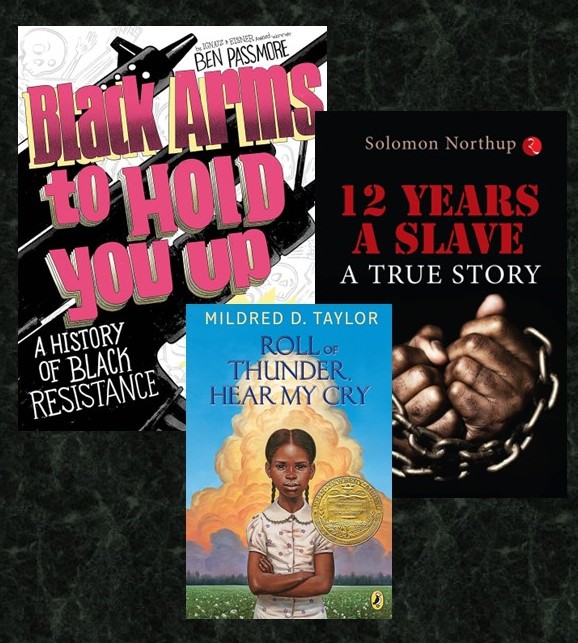
12 Years a Slave is both a terrific historical record as well as a compelling film. An actual firsthand report of a free black man kidnapped and imprisoned in slavery in the 1800s south, this story should tear out your heart and fuel a certain level of rage and empathy. Deniers of the harm of the “peculiar institution” should not even be allowed to debate until they have studied this short and simple work. The appendices contain actual court records that confirm much more accurately the horrors of this time than most of our contemporary court records show the political bias of our judges. Every American, everyone who claims to be Christian, anyone who believes themselves to be ethical and moral beings should read this book.
Black Arms to Hold You Up may fly under the cultural radar because it is a graphic novel. I grew up in predominantly racist Muncie, Indiana (I was invited to my first KKK meeting in 1970 when I was twelve) and only heard the white supremacist side of these stories. As I escaped the narrow-mindedness and hateful ignorance of my youth, I heard only references to some of these acts and actions of black resistance. I virtually never heard them in context, and from the black perspective. This book was a revelation and a shame. History is indeed written by the winners, and most of the winners are white/privileged/straight/educated/older males, so it is not any wonder that most of the tales of black resistance are of uneducated, violent, sex-crazed brutes. You know what? Most of this history is heavily biased and inaccurate, no matter what current administrative despots might want you to believe. Read these three books, then let’s talk.
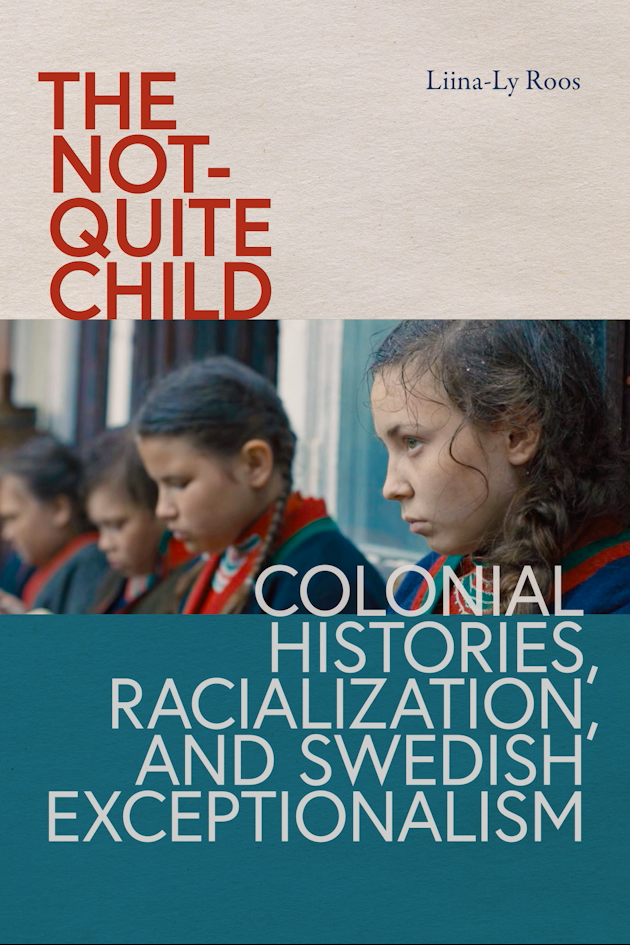
Okay, full disclaimer. I picked up this book because I know (respect, admire, and adore) the author. Dr. Roos is a member of People’s United Methodist Church in Oregon, Wisconsin, where I last served. She is a bright, caring, interesting, and extremely personable woman who just happens to be brilliant and exceptional. BUT…
The Not-Quite Child blew me away. With my apologies to Liina-Ly, my expectations were a little low due to the subject matter. This is a niche academic work produced by an academic press for a relatively small academic audience. And that is a shame, because this is a provocative, incisive, and highly accessible book that far exceeds the parameters of its subtitle. Not only is it an exemplary model of Nordic cultural analysis, but it is a first-rate work of film and literary criticism, social and anthropological assessment, and a serious and stunning critique of racism, bias, nationalism, and the development of a mythological exceptionalism. Dr. Roos’s detailed exploration of the development of a national identity based upon a Utopian vision of childhood steeped in a sub-paradigm of racial and ethnic prejudice is a humbling reflection on the current reality in the United States and an administration devoted to erasing the horrifying parts of our history, pretending they never existed. With every page, The Not-Quite Child set my mind reeling with associations and parallels in our own cultural miasma. This is an important book, wonderfully researched and written, that I pray might reach a much wider audience than its academic target.

1984 and Philosophy: Is Resistance Futile? –
edited by Ezio Di Nucci and Stefan Storrie
Would you like to have a clearer understanding of what is happening in U.S. culture these days? Then, first I suggest you read George Orwell’s 1984, but then, take time to read this thoughtful, provocative, and incredibly prescient (published in 2018) set of essays.
Yes, this will reflect poorly on the populist movement in our country, so it will obviously present a bias against the MAGA wing of the Republican party and the current White House, but if one can look beyond the partisan polarization of our current day, and see the overall trajectory of our America(s) since the Reagan-era.
But the importance of reflecting on freedoms, truth, global relationships and engagement, the climate, wealth inequality/power inequality, our reverence for warfare and hostility, and the reality of a hyper-linked post-factual world has never been greater.
Rational thinking, personal rights, responsibilities, liberties, protections, freedoms, due process, etc., are all vulnerable and fragile currently, and therefore are very easy to manipulate and obfuscate. If you care about reality, truth, the past, the present, or the future, this is a book worth reading.
Sherman Alexie –
The Absolutely True Diary of a Part-Time Indian/The Toughest Indian in the World/The Lone Ranger and Tonto Fistfight in Heaven
I have no idea what it means or feels like to be Native American in today’s U.S. Empire culture. I cannot conceive of what remains of a proud and ancient heritage, what has been lost, what has been taken, what has been violated and destroyed for all time. I certainly cannot imagine how native peoples maintain any kind of sense of humor. Thus, I stand in wonder and amazement at the incredibly personal, powerful, and poignant writings of Sherman Alexie.
Alexie, for reasons beyond my comprehension, has been a controversial figure, even having many of his books challenged, restricted, or outright banned. These facts should make most intelligent, compassionate, and curious among us deeply committed to reading his work. Not all of it is brilliant or terribly insightful, but all of it reveals a worldview and perspective alien to most U.S. citizens. While historians focus on broken treaties and promises and the need for reparations, Alexie devotes his time and attention to the lived realities of those relegated to reservations and generally treated as second- or third-class citizens. He makes the story in hi-story real.
Too often we spiral downward into stereotype, labels, and nameless/faceless masses when we talk about racial, ethnic, and cultural differences. It can seem that we aren’t talking about real flesh and blood human beings. We speak of “others” as if they are two-dimensional cut-out felt-board figures. We don’t begin to find common ground, but focus almost exclusively on the differences.
Liberal digression forces meta-themes of diversity, pluralism, inclusion, and cultural sensitivity to displace simple, straightforward narratives of our human siblings doing their level best simply to get by. Alexie offers characters and characterizations that offer a glimpse into the good, the bad, and the ugly of native generations of men, women, and children doing the best they can with the hand that is dealt them. And if we learn something about the injustices, inequities, injuries, and inhumanity suffered by millions of our human family, maybe we will be motivated to do something about it.
 FaithQuest Revisited