Among my greatest disappointments, not being able to follow-through on the UM Worship Patterns project is near the top. I have not engaged in a more interesting — and potentially helpful — project in all my time in research. This article is a companion to Theology of Worship? and Preacher Feature and wraps up the trilogy of summaries from this brief study.
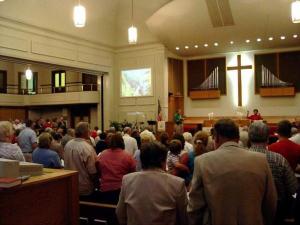 The central question at the heart of this work is: “What do people expect to happen in worship?” We looked at the question from both the worship leader’s perspective as well as the person in the pew. It touches on other significant question’s such as , “Why do we offer worship?” “Why do people come to worship?” and “What effect does worship have on people’s lives and faith development?” Over 5,500 people participated in this project from 2000-2008 — 5,419 laity and 227 clergy from all five US jurisdictions, and representing accurate demographics across race, age, and gender. (Note: efforts were made to reflect the social demographics of the United States, not the demographics of The United Methodist Church. This means ours sample is younger, less female, and much more racially diverse than the average United Methodist congregation, but more accurately resembles “the real world.”)
Why People Come to Worship?
For the vast majority of United Methodists, worship is both a personal and private affair. Though some come to church to see friends, during the worship hour 88% of worshippers are seeking something for themselves. What they seek falls into three broad categories:
- comfort and encouragement
- guidance (and sometimes, challenge)
- knowledge (about God and about God’s will)
In all these cases, worship is about receiving more than giving. Different respondents explain how worship is like “a port in the storm,” “a filling station,” “a time for rest and recovery,” “a place to better understand God,” “a safe space (sanctuary) in a crazy world,” and “time to shut out the world.” Virtually no one in the sample, pastors included, frame their experience of worship as a “giving” experience rather than a “receiving experience.” This tends to be both a Western and a modern conceit of worshippers. Interestingly, there is very little difference between ages, genders, and races in this “giving/receiving” dynamic of worship.
Focus of Worship
Five very distinct foci emerge when you ask questions about the object and subject of the worship experience. They can be described as:
- for us, but about God — we focus on God in worship, but the real beneficiaries are the worshippers. We use God talk, but it really is all about us, and if worship doesn’t serve our needs and fill our hungers, we won’t bother with it or we’ll look elsewhere until we find it. (48%)
- for God, but about us — we focus on the human condition, the world, contemporary issues, our failings, hopes, and dreams all seeking to become God’s people and to better understand God’s will (16%)
- for us, about us — we focus on being good people in a complex and demanding world, using a heavy amount of self-help language, but not using a lot of “God/Jesus/Spirit” language. Generally aimed at younger audiences, though younger audiences tend not to find these experiences that appealing. (9%)
- for God, about God — we focus on God and don’t clutter up the worship experience with a lot of extraneous activity (announcements, mission minutes, funding appeals, videos, performances, etc.) Tends to be highly interactive (liturgical), simple, and grounded in prayer and scripture. (4%)
- worship as routine — focus and purpose is vague. We offer worship because that is what churches do on Sunday mornings. The elements of worship are present, but there is little clarity as to why we’re doing what we’re doing. (23%)
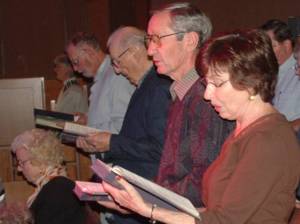 It is somewhat alarming that almost 1-in-4 United Methodist congregations lack any real clarity about the purpose and objectives of worship. The centrality of God to worship is only high for only 1-in-5 (20%) of United Methodists. In post-worship interviews with worshippers, only 17% (1-in-6) can remember what was specifically said about God/Christ/God’s Spirit in the worship service they just attended (this interview occurs within 10 minutes of the conclusion of worship), even when allowed to refer to their bulletin. When the subject of the message is about popular culture, a personal story or instruction for the worshipper, the percentage of recall jumps to 57%.
Most important to United Methodists is the comfort of the familiar. The most meaningful worship is worship that contains and offers familiar scriptures and stories, familiar hymns, familiar patterns and rituals, and easily recognizable references from popular culture. When people feel comfortable in worship and the elements are familiar, worshippers remember and retain more from worship. (Where worship is familiar, 37% can recount the worship experience fairly accurately, compared to 22% where worship was unfamiliar and lacked recognizable elements).
High Expectations of Low Expectations
Almost everyone (96%) in our survey could articulate very specific expectations for the worship experience. However, a significant majority of responses were for basic, somewhat pedestrian, expectations. Grouping the responses in seven general categories, the expectations are as follows:
- good music, good preaching (34%)
- to feel good, feel better (31%)
- to spend an hour (or so) doing what good Christians do (14%)
- to get guidance about living a “Christian life” (11%)
- to learn about God (7%)
- to be challenged in the way I live my life (6%)
- to give undivided attention to God to give thanks and praise (5%)
(These do not add up to 100%, because many people offered a composite/hybrid answer that didn’t fit just one category.) More important than the actual numbers is an interesting critical divide: 75+% of United Methodist worshippers have little or no expectation of being changed by the worship experience. Only a small minority are looking for guidance to change or a fundamental focus on God and God’s will.
We followed up on the issue of personal change with almost 100 phone interviews. What we heard confirmed the initial finding: 87% of our interviewees reported some form of “the idea of personal change in my life because of worship,” is completely foreign to them. However, 82% reported that a significant change in their life (generally negative) would certainly motivate them to attend worship. This is further evidence that most people see worship as being for and about them (or for them, about God).
Teaching Worship
United Methodist church leaders do not teach people how to worship, they merely assume everyone can, will, and will understand what is happening and why. Outside of confirmation classes and a few Sunday school groups, only 17 congregations (1.7%) actively teach worship practices — and this is on a rare, occasional basis — often once every ten years or so. Our interviews indicate that most regular worshippers in our churches (4-out-of-5) do not know what a doxology or benediction are (by definition, that is — they know they have them, but they don’t know why), cannot define a creed, 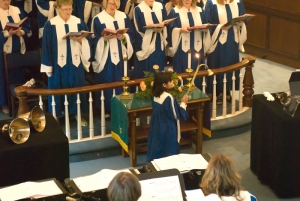 do not know the meaning of “liturgy,” do not understand the differences between types of prayer (confession, intercession, petition, adoration, benediction, etc.), have no clear theological understanding of “offering,” nor do they know what the words “psalter” or “epistle” mean.
Worship in An Entitlement Culture
Worship is a “me” experience in United Methodism rather than a “we” experience. 91% report that, while it is nice to be part of a congregation (especially when it comes to music), they can worship every bit as well by themselves as they can in a group. The church is a convenience rather than a necessity. In an entitlement culture, people believe they have a right to things with little or no responsibility to provide them for others. This is very true in the church. Most worshippers in The UMC believe that attendance and financial support are optional and should be left to the discretion of the individual, but they expect that the church will provide for whatever needs they might have without condition. People want to know that the church is offering worship services regardless of their intention to attend. We asked regular worshippers if they had any responsibility to the other worshippers in the congregation. 74% needed us to explain what we meant, and overall 85% said ‘no,’ 9% said ‘yes,’ and 6% ‘don’t know.’ The idea of worship as a fundamentally communal act is of low importance to most Methodists — they don’t much care whether other people are in worship or not.
Where’s God in Worship?
We asked a very pointed question — one with which we ended our study — because it may be the most important and the most perplexing: “Do you expect to have an experience of the living God, the risen Christ, or the power of the Holy Spirit when you worship?” We got four basic responses:
- No (72%)
- Have never thought about it/don’t understand what we mean (53%)
- Would like to (13%)
- Yes (11%)
(Once again, there were some multiple answers: “no, but I would like to; yes I do, but I would like to more often; I’ve never thought about it before, but no I don’t…”) Additionally, out of 227 pastors/preachers in the survey, only 8 (!) claimed that they “expect people to experience God/Christ/Spirit” in worship. Worship in UM churches is “about” God, and often “for” God, but seldom “with” God. 44 answered that they “hoped” people would experience the divine, but a hope and an expectation are two very different things.
This brief, truncated study, was incredibly illuminating and raised a host of questions. We offer some of the questions we have wrestled with as conversation starters for worship leaders near and far:
- What is the purpose of our worship?
- What do we want people to experience when they worship here?
- What is the focus of our worship?
- Who is our worship about? Who is it for?
- What is the role of God, Jesus, the Spirit in our worship experiences?
- What do we “expect” worshippers in our church will experience when they worship here?
- How well do we understand the motivations of our worshippers to worship?
- How well do we “teach” worship?
- What is the significance of worship in the life of a Christian disciple?
- How do we help people recover a communal sense of worship as the work of the people of God rather than a collection of individuals?
If you have other questions, please share them. Almost everyone agrees that worship is crucial to the life of our congregations, but these brief research reports indicate that we have enormous room for improvement.


 FaithQuest Revisited
Leave a reply to doroteos2 Cancel reply