My commentary on the research on evangelism and faith sharing in The United Methodist Church generated some interesting response — some defensive, some reflective, but no one really surprised by the conjecture that we’re not doing very much in the way of inviting people into  relationship with Jesus Christ. I indicated that I think this might be a problem, but that is only my opinion. I wanted to follow up with a ‘part two’ that shares the opinions of some of the people we interviewed. Two of my colleagues — retired researchers Harold Jones and Tom Perry (and I don’t want to hear any jokes about research being done by any old Tom, Dick & Harry…) — helped me conduct 47 telephone interviews, and these conversations shaped some of the conclusions I drew in the last post.
Let me just set the stage, then I will get out of the way and present a collection of quotes from active United Methodists. We recorded each 20-30 minute conversation, so the quotes are essentially verbatim (though we cleaned up the ‘uhs,’ ‘ers,’ “likes,’ and other quirks of conversation. There were some common themes and shared feelings among the 47 interviewees. Here are a few distinctions that may help along the way:
- Evangelism tends to be heard as either a negative term — based on negative stereotypes of people pushing their faith on others or televangelists — or something that the church should do, but that the individuals do not view as their responsibility.
- Faith sharing is a much more acceptable term than evangelism, but it is interpreted as talking about their faith within their own congregation or family.
- Four-out-of-five (39 of 47, or 82.9%) people interviewed define evangelism as “inviting people to come to church.”
- Virtually no one (2 of 47, or 4%) remembers ever being taught how to share their faith with people outside the church.
- Not many more (4 of 47, or 8.5%) say that they would like to be taught how to share their faith with people outside the church.
- Three-out-of-four people interviewed said they don’t think it is their responsibility to share their faith with others; that faith is essentially both a personal and a private matter.
Okay, here are some of the things people told us…
I never invite people to church because all the people I know already go to church. The people at my office… I don’t know if they go to church, but it would be completely inappropriate for me to ask.
I don’t know enough about the Bible to talk about it with other people. I am sure people will ask me questions I won’t be able to answer. (We asked if knowing more Bible would help build confidence?) You know? Not really. I’m still not sure I would feel comfortable talking to other people about the Bible.
My church does evangelism. I don’t do evangelism. Anyway, I think it is up to each individual person to decide whether they want to go to church or not.
I’m not a knock-on-doors, hand-out-tracts kind of person. It turns me off when people do it to me, and I have no desire to do it to others.
I think my church has offered a class on evangelism, but I didn’t go. I really don’t have any interest in that holy-roller stuff.
I keep things on my desk — you know, like I have an angel and a crucifix (yes, this is a United Methodist), and on my wall I have the poem “Footprints” — and so people know I am a Christian if they care to find out.
I used to listen to a Christian radio station at work, but I overheard people making fun of me, so I switched to an oldies station. I can’t stand it when people mock me, and my faith is way too important to me to be made fun of for it.
I can’t remember the last time I talked to anybody about God. I personally feel that my faith is nobodies business but mine.
I would love for everyone to know God like I know God, but I would never force my beliefs on anyone else.
I would be really embarrassed to talk about religion. It’s like politics. All it does is start fights.
I do try to talk to people about God, but not many people care or want to talk about it. It’s like, ‘that’s nice,’ then people just go on doing what they’re doing.
I asked a neighbor to church once year’s ago and it really made him uncomfortable. I learned my lesson. I don’t want to put people on the spot.
No one is interested in my beliefs. If people haven’t checked out the church by now, nothing I say is going to make any difference.
I have three girlfriends who go to a holiness church who are asking people to come to church all the time. I see the way other people make fun of them and I keep my mouth shut. (We asked if these three women have gotten anyone to attend their church?) Oh, yeah, like twenty people have gone!
I have a small group at church. We share our faith all the time. We talk about Jesus Christ every week. I feel very good about talking about God.
Our pastor told us that evangelism is a spiritual gift and that most people don’t have it, and that if you don’t have the gift you shouldn’t try to do evangelism. My gift is caring.
Our church does great evangelism. We have both a public access television broadcast and a radio ministry and our conference has put up billboards inviting people to church. (We asked if individuals in the congregation ‘did’ evangelism in addition to the church’s efforts?) Not so much. It’s better to leave the invitations to the professionals.
Our pastor brings in lots of new people and we have visitors, so I guess we are pretty effective at evangelism.
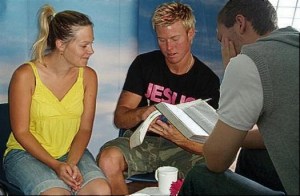 These quotes provide a sampling of the kinds of attitudes and perspectives United Methodists hold concerning the sharing of our faith. They are not intended to chastise or condemn anyone — everyone has a right to their opinion. However, they provide a snapshot of our current reality, and they may provide insight into the numeric decline within the denomination, as well as a challenge to share the good news of Jesus Christ with the world. It is interesting how “the church” has displaced “Jesus Christ” as the object and subject of our evangelism, and it is worth noting that most spiritual seekers are looking for help building a relationship with God and Christ, not the institutional church.


 FaithQuest Revisited

Leave a reply to Scott Endress Cancel reply