Someone I went to seminary with passed away recently, and I found it interesting that colleagues and members of his churches fondly and appreciatively noted that “he was so dedicated. He must have worked 80 hours a week, at least!” Many people made mention of his Herculean work style, often with reverence and awe. No one seemed to question that perhaps his amazing “dedication” may have contributed to his passing from heart attack and stroke at the age of 54. People have always been easily impressed by reckless, dangerous, and downright stupid acts, so I guess it shouldn’t be surprising when we stand and applaud the poor soul who neglects home, family, health and well-being to work round the clock seven days a week, 365 days a year. At some point, though, we’ve got to ask ourselves, “Is this really such a good idea?”
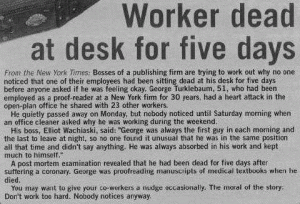 I understand why we do it — I even understand why we think we need to do it — but I wonder if we are being too shortsighted. Certainly there is always enough work to fill any capacity we allow, but generally the world doesn’t end when we fail to get everything done. Not only are we not as critically essential as we think we are, but there is mounting evidence that those who put in 65+ hours a week are less productive, effective, and healthy than those who work 50 hours or less. Stress, exhaustion, fixation and obsession are rarely good things and they detract greatly from performance. They lead to burn-out, personality disorders and physical illness. And for spiritual leaders there is an added downside — is this the kind of “abundant life” we want to model for those to whom we witness and serve?
But how do we break the cycles? Churches are voracious beasts, consuming as much of our time, energy, and effort as we can produce? How do we recreate our working relationships once people come to expect us to be continuously at their beck and call? I don’t think there is a single answer, but there are a few guidelines of pastoral leaders who do it well that might be helpful.
 When I did the Vital Signs study, one of the most striking facts about effective leadership was that the healthier the congregation, the fewer hours pastoral leaders and paid staff had to work. In the least healthy congregations (even those growing numerically by leaps and bounds) the pastors worked an average of almost 70 hours. In these churches, the congregation’s success was very pastor-dependent. In our healthiest churches pastors work an average of 49 hours a week. What accounts for the difference? Three things: clear congregational priorities, collaborative negotiation of time, and intentional self-management.
Clear congregational priorities— Okay, how many balls can you juggle comfortably? Most people can keep two going without too much trouble, some can handle three and a few truly exceptional people can manage four or five or even more. What is true of juggling is true of effective performance vocationally as well. Most people can attend effectively to two or three things, but performance suffers greatly by adding more. In parish ministry, where do we focus our attentions? There are dozens of demands, many competing for the same resources. Our arms are loaded with “balls,” but we’re not juggling — we’re simply trying not to drop any. This is stressful and joyless. It isn’t really “performance,” but maintenance. The healthiest congregations have determined together — clergy and laity in concert — what the critical priorities are for the whole community of faith. In such situations, pastoral leaders can focus their time and energy where they support the top priorities of the congregation. Priorities allow people to better understand what is truly important — what to say “yes” to and what to say “no” to. Without clear priorities, everything appears to be of equal importance, so instead of three balls to keep in the air, we end up clutching a dozen or more.
Collaborative negotiation of time— the healthiest leaders don’t struggle to make decisions about how to use their time all alone. They work with others to negotiate a reasonable expectation for the way they allot their time. This is, in The United Methodist Church, a primary function of a Pastor-Parish- or Staff-Parish Relations Committee. Pastors are servants of the congregation, but not slaves. Every pastoral leader is uniquely gifted to lead and to serve. It is in the congregation’s best interests to utilize the pastor’s gifts to best advantage. Making sure that a pastoral leader is free to do what she or he does best is a win-win situation. We often receive less value from our leaders by demanding they focus their attention on things they do not do well — diverting their energy from those things at which they excel. In our healthiest churches, pastors and PPRC/SPRCs or an equivalent group decide together the best use of the pastor’s time — including days off, sabbath time, renewal leaves, learning needs, and other restorative practices. In some cases, district superintendents can step in to assist the process. The importance of negotiating time is as great for the congregation as it is for the pastor. Many congregations are completely unaware of how destructive their dependence on the pastor and other paid staff can be.
Intentional self-management — the healthiest leaders aren’t trying to prove anything to anyone. They know their strengths and they openly admit their weaknesses. They work to maximize their strengths, and they do very little to compensate (or hide) their weaknesses. They understand their limitations and they are clear on their own values — what is most important to them and what they refuse to compromise. Healthy leaders have the healthiest relationships at home. Their call to ministry and work for the church does not cause harm and damage to home and family. Healthy leaders KNOW what is important to them and the establish healthy boundaries to protect these things. They don’t let unexpected demands seep into their time off. Certainly they must be flexible and an untimely death or unexpected emergency will crop up from time to time, but they do not live at the mercy of other people’s demands and agendas. If the electricity goes out at the church, it isn’t up to the pastor to get it back on. If the copier runs out of toner, most parishioners are capable of figuring out how to get another cartridge and install it. If the boy scouts left a mess in the fellowship hall, other hands than the pastors can clean it up. In what other profession would we pay someone to preach, teach, and lead then use them to mow the lawn or set up tables? No one else will set boundaries for a pastor — pastors need to proactively work with others to make sure the boundaries are clearly understood and communicated.
 There is a great article in the October 2009 Harvard Business Review, “Making Time Off Predictable — And Required,” which indicates that job satisfaction, longevity, balance of work and home, learning, communication, and performance all improve by working less rather than more. The “work smarter, not harder” adage applies. Time off — for renewal, rest and recovery is NOT a luxury, but a necessity. As pastors, we have no excuse not to teach Sabbath time by modeling it. Remember, a day off is not Sabbath. Picking up the dry cleaning, going to the bank and the hardware store, before taking in a movie is not the same as a day for personal spiritual renewal. Pastors who work too many hours end up praying less, reading devotionally less, worshiping less, studying less, and meditating less than pastors who work fewer hours.
So, the bottom line is: take control. Don’t be a slave to clock and calendar and task list and email and cell phone. Unplug, disconnect, and withdraw — but do it collaboratively. Healthy self-care rarely happens in a vacuum. We need advocates and defenders. We need people to hold us accountable and shove us out the door. We need someone who will hide our Blackberry and steal the battery from our laptop. We need people who care enough about us that they don’t want to stand around at our funeral saying, “She was amazing! She never took a day off or a vacation in all the time I knew her!”


 FaithQuest Revisited
Leave a reply to Rex Nelson Cancel reply