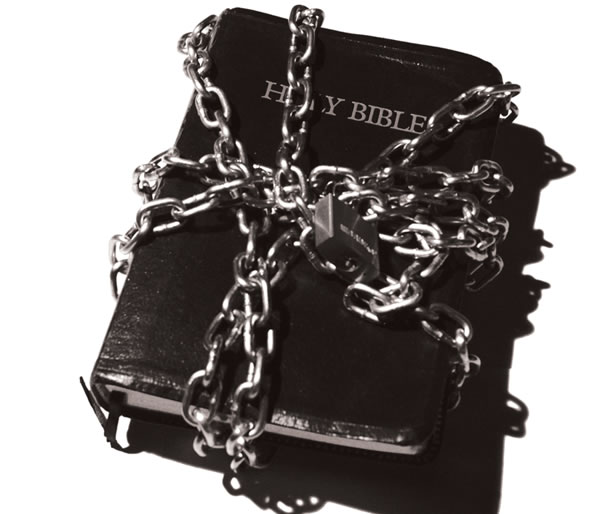
 There is one phrase I hear that just drives me crazy when it comes to the Bible:
I don’t interpret scripture; I just read it and do what it says.
Basically, this is a false statement intended to end discussion by claiming that the person speaking has a crystal clear understanding of what God intends based on his or her personal favorite translation of the Bible. No need to interpret — simple know. Yeah, nice try. The human brain doesn’t work that way. Any information received is immediately processed through multiple conscious and subconscious filters. We have no control over some of the interpretation in which we engage — it is simply an automatic response triggered by a wide range of factors. I was listening to a group of men discuss the discipline of children when I stopped for coffee this morning, and this was the nature of the exchange:
The Bible says, “spare the rod, spoil the child,” and I’m all for paddling a little respect back into some of these kids.
You can’t hit kids today!
The Bible says you can — it says you should.
That was for a different time and a different place. We’re grown more civilized since then.
Problem is, kids haven’t changed that much. They still need guidance and discipline.
Which you can give them without hitting them.
I’m not talking about abusing them. I’m talking about dropping their drawers and paddling them, like the Bible says.
Yeah, and the Bible says that if children disappoint you, you can put them to death. Should we do that?
That’s just stupid. I don’t even think the Bible says that.
But if it did, would you say it was okay to do?
I’m not talking about killing kids; I’m talking about knocking some sense into them!
You know, the phrase “spare the rod, spoil the child” could be taken metaphorically.
Oh, shut up.
In essence, this is a microcosm of every Biblical-theological debate I have ever heard or been a part of. Form critics (what purpose does the pattern of communication serve to preserve the oral tradition from which it comes?) and source critics (where did this come from and what did it mean in its original context?) and redaction critics (why did the writer choose this particular concept and what point is he/she trying to make?) and literary critics (yes, but what does this passage say to us, today?) vie for attention with everyone who reads any passage of scripture — and individuals often preference one to another.
I am a historical accuracy junkie. I believe that original authors and redactors had a purpose in context for writing what they did. Certainly, a passage may have a universal and timeless message, but each passage was written by someone for some purpose, and know what that purpose was is important to me — and it conditions what I think the Bible means today. I understand the passages about slavery in their historic, cultural, and geographic context — and I in no way think they give anyone license today to enslave another person. I understand some of the approaches to “demons” in the Bible and they make sense in a pre-scientific culture that knew very little of disease and brain function. I understand the historic-cultural injunctions against inter-racial marriage, masturbation and homosexuality in a time and place where the perpetuation and expansion of the tribes was so vital, but I am not sure that — even if they came directly from God — they were meant to be universal and eternal. Literary critics would (and often do) disagree. I can still remember my grandmother’s pastor waving a King James Bible in the air while he preached, claiming it was “the Word of God transmitted to us in God’s own words.” I once asked him how we know what the Bible means, and his response was simply, “it means what it says.”
We place a premium on “getting the Bible right,” — acknowledging that no other writing such have such authority over our thoughts, words and actions. The Bible is IMPORTANT. We are a people of a book (though, don’t get me started on how poorly we read, study, understand or apply most of it — we only seem to use it to figure out what other people shouldn’t be doing, instead of working together to discern what WE should be doing…) and so we do not take it lightly. But what we seem to take even more seriously is our own ability to KNOW exactly what every word means and intends. We are incredibly legalistic in our working out our own salvation with fear and trembling. When it comes to the Bible, many people have a difficult time admitting “of course, I might be wrong…”
Metaphorically, the Bible may be used as a tool for building, a shield for protecting, or a weapon for attacking — sometimes all three in quick succession. What I would suggest is that we intentionally USE the Bible to create rather than destroy, to enlighten rather than to blind, to engage rather than attack, and the unify rather than divide. Our first commitment could be to always use the Bible as a tool, and only use it defensively when our options are limited, and to use it as a weapon only as a last resort when we feel God has abandoned us and we have run out of options. Since God will never abandon us, then I guess we will never have to use the Bible as a weapon again!


 FaithQuest Revisited
Leave a reply to The “Not-For-Prophet” Cancel reply