I have been reading both Bruggemann and Block (The Word That Redescribes the World and Community/Abundant Community) and have been challenged in my thinking to a great degree about how we live together in healthy Christian community. Both books press a very simple, yet signficant distinction between two Cs: consumer and citizen. I am not generally a comfortable “either/or” thinker, but this distinction is as concise a characterization of the challenge facing mainline Methodism that I can think of — a dividing line that explains a lot about our fractured and under-functioning church.
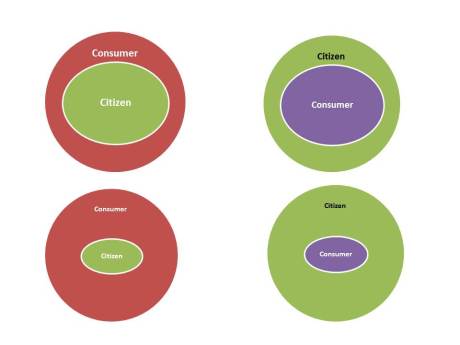
Actually, this isn’t truly “either/or,” because each of us occupies both spheres simultaneously. More it is a matter of which holds the core and which is secondary in our psyche and worldview. If I am essentially a citizen, I will define myself by my responsibility to others, by my ownership in a common vision and shared values, and the contribution of my gifts, energies, and resources to a common good. I will also enjoy the benefits of strong relationships and I will receive much that makes me happy and satisfied — I will consume the fruits of healthy community along with everyone else. If my citizenship core is less pronounced, I will still offer what I can, but much more when it is convenient, comfortable, or least-costly. I will serve from my sense of obligation, but with much less satisfaction.
On the other hand, if my core is grounded in a consumer mentality I will focus on my own rights and privileges, demanding entitlement, and investing only in those things that provide value to me. I will participate as a citizen if and only if my needs/wants are first met. I will not be motivated by messages of duty, responsibility or obligation, because I am engaging as a recipient and a beneficiary, not a provider. If my consumer core is small, I will demand little and will contribute much — to the things that are of interest and value to me.
The church parallels are pretty clear. A church grounded in citizenship offers the possibility of true community, while the church centered in consumerism is a service-provider at best. Citizens contribute, serve, share, and set aside personal agendas for the good of the whole. Consumers take, demand, expect, and judge. Citizens are committed to building, and are therefore more flexible in the face of change. Consumers are finicky and often set in their ways, making resistance to any change that does not directly benefit them their default setting.
Our problem is that we have not been cultivating citizenship as the norm in United Methodism, but we have pandered to the consumer mentality — and I am not just talking about sipping coffee and buying a T-Shirt and a CD while I wait for the valet to bring me my car after church (though this skeevy image does set my teeth on edge…). The consumer mentality that we have fostered is more generic and widespread. As congregations and congregants we attend if and when we feel like it, we view prayer and other spiritual disciplines as options, giving is a personal and private matter, and if we disagree with any little thing the church does, we will withhold our giving. We are freely critical of the leadership at all levels, but see no reason to step up and lead ourselves. If there is a disagreement, we will turn it first into a “win/lose” battle, force our own way until things turn ugly (damn the consequences), then walk away if we don’t get what we want. We will stay in, but only if “those people” stay out. We will come to church if we like the pastor, but heaven help the poor schlub who preaches poorly or says something from the pulpit with which I disagree!
And the numbers game is at fault. Once United Methodism sold its soul to institutional empire-building (then preservation), the game was over. Community becomes impossible when expansion is the driving goal. The quest for more is an all-consuming and consumptive pursuit. As we enlarge, we degrade. And when a guiding value is to be big, you do nothing that might alienate or irritate the lowest common denominator. In short, you pander. Keeping a disengaged, passive, non-contributing consumer on our membership rolls becomes more important than equipping a highly motivated, multi-gifted disciple-in-formation. And so it goes.
What if we established citizenship as our baseline standard for inclusion in the body of Christ? What if we actually expected something from the participants in our congregations and held them accountable to a set of standards? What if we allowed those who are consumers to show up, but we stopped gearing our efforts to appease them and instead did everything in our power to cultivate citizens? It will never happen. The day we do it, two-thirds of our consumer brethren and sistren will take a hike, leaving a core of real citizens without the material means to prop up the church that means so much to consumers. Oh, wait… this wouldn’t be a bad thing!


 FaithQuest Revisited
Leave a reply to Ben Cancel reply