I am currently attending my first board meeting with the General Board of Church and Society.  Up front, let me say that I think this is one of the most important, most valuable of our general church agencies.  I understand that this view is not shared by all.  In fact, some vehemently oppose Church and Society, and it ALWAYS surprises me.  I have written in the past that I feel United Methodism suffers today by a lack of institutional memory and an abdication of our core identity.  If your tradition is the Evangelical Association, the Methodist church, or the United Brethren in Jesus Christ, then you are part of a biblically and theologically grounded tradition that elevated missions, evangelistic witness, and a commitment to social justice — in other words, a church that isn’t all about us, but a church that exists for the purpose of serving in the community and world.  You may disagree that these things are important, but you can’t change history — this is who we are based on who we have historically been.

In preparation for my first term on the board, I began receiving letters almost as soon as jurisdictional conference ended — all of them highly critical, negative and derogatory about the work of Church & Society.  The comments boil down to three essential ideas:

  1. Christians should not get involved in politics.
  2. Social justice is communism/socialism/liberal, and therefore to be avoided by good Christians.
  3. We should not spend money on sinners; i.e., the poor, immigrants, single mothers, homosexuals, foreigners, scientists, political advocacy (these were just the specific things named in the letters/emails I received).

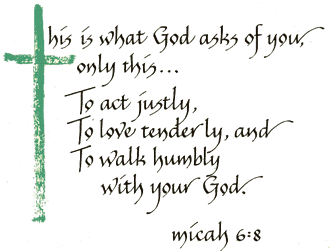
I disagree with a lot of people about a lot of things — and a lot of people disagree with me, but this is one of those issues that truly stymies me.  Hebrew scripture — history, poetry, prophecy — makes it clear that peace, mercy, justice, care of the poor, the marginalized, the stranger, the alien are not options, and that they are required of both individuals as well as communities, tribes, households and nation.  These things are even clearer in the gospels, the writings of Paul, James, and other writers of the early church (both in and beyond the accepted canon).  This reading doesn’t require much in the way of interpretation — it is clear, concise, constant, and consistent.  In our culture and age, Matthew 25 is a complete impossibility apart from political and social engagement.  Of all our general boards and agencies, Global Ministries and Church & Society are the two that actually live out our biblical, theological, and denominational mandates.  We can ascribe all kinds of negative labels to living the gospel — socialism, communism, etc. — but caring for God’s creation by realizing that we are all one creation, never in ministry “to” or doing ministry “for” but living into the realm and reality of God “with” each other is simply awakening to the will of God.  To eliminate the false, destructive, and indefensible dividing walls of hostility of “us” and “them”, is to live with integrity as the body of Christ.  It is so amazing to be part of an agency of the bureaucratic institution of “the Church” that actually gets it — that puts faith into action and activates disciples of Jesus Christ to engage in work that God actually uses to transform the world.

United Methodists can be proud of the vision and commitment of the General Board of Church & Society.  Not everything C&S does will please everyone, and there will be some things that we choose to politicize and castigate based on personal biases, but in the main, Church and Society is doing excellent work that allows us to fulfill our scriptural mission, honor our theological heritage, and strive toward our denominational values and priorities.

30 responses to “Church Or Society”

  1. Tom Lambrecht Avatar
    Tom Lambrecht

    Congratulations, Dan, on your assignment to Church and Society. May you find it a challenging and fulfilling experience!
    It might surprise you to know that I believe a healthy and robust Board of Church and Society is essential to the effectiveness of our church. What frustrates me and a lot of folks is not in the goals, which you rightly remind us are rooted in Scripture, but in the means to those goals. We might all want world peace, for example, but some believe that unilateral nuclear disarmament will lead to peace, while others believe that a strong nuclear deterrent will lead to peace.
    Where GBCS could serve us well is to foster discussion of alternative means to a common goal. Instead, GBCS tends to adopt one particular philosophical approach to solving social problems, namely, a big-government, semi-coercive approach. That is why many people equate the UMC’s social positions with the Democratic Party platform.
    GBCS should recognize that there is more than one way to skin a cat. Exploring alternative solutions, rather than emphasizing only one course of action, would gain GBCS credibility with people in the pew.

    1. John Meunier Avatar
      John Meunier

      Tom, your proposal is interesting and probably doom to be ignored. What would that look like in practice, I wonder.

      1. Tom Lambrecht Avatar
        Tom Lambrecht

        InterVarsity Press used to put out books like “Four Views of the Rapture,” where proponents of each view would state their position, followed by critiques from the other three. What if GBCS produced resources like “X Views on Immigration,” with several different proposed solutions (all from a Christian perspective) and critiquing each other? That kind of approach (rather than endorsing only one solution) would enable dialog and learning to take place and perhaps enable us to move toward a more consensus understanding and a more comprehensive solution to problems. At the very least, there might be elements in each solution that all could agree on.

    2. Dennis Avatar

      I should start off by saying I’m not a Methodist but a Disciple. I agree with Tom in a sense that some of the bad feelings about agencies like the Board of Church and Society is where things end up. I totally agree with Dan in that the Biblical call to justice is clear. I don’t think you can get around that and we ignore that call to our peril.

      However, what I think trips people up is that these denominational agencies will talk about justice and they asking for solutions that fall right in line with the Democrats or liberalism in general and it is held up as the biblical way to pursue justice. I think that turns folks off because what it says is that to be involved in social justice you have to adopt this approach and this approach only.

      Now, I think on a practical matter there is a case to be made for dealing with issues like feeding the hungry or housing the homeless through government initiative. But Scripture never said that you can only be just through the so-called welfare state. God demanded that we get it done, God did not say how we should get it done. When agencies basically back one horse over another, people notice and that group loses credibility.

      What I love to see is religious agencies act more like think tanks, offering ideas on how to best solve an issue and making recommendations instead of backing one approach and making it the word from on high. If we can engage the folks in the pews too think creatively on how to solve issues, there might be more folks that don’t look down on groups like the Board.

      1. Tom Lambrecht Avatar
        Tom Lambrecht

        I couldn’t have said it better, myself. Thanks for articulating my thoughts so well, Dennis.

  2. ******** Avatar
    ********

    Maybe I’m yielding too much in the way of “benefit of the doubt,” but I wonder if the issue has something to do with cultural indoctrination. What I mean is, I have friends both liberal and conservative…and I love them all dearly. I often hear them recite the things they hear from their respective news sources, talk shows, etc. I try to learn as much as I can by listening/reading from these sources, then “speaking the language” when I have conversations. Yes, sometimes the rhetoric is what plays out. But underneath the rhetoric, there are often deep struggles…that often center on trying to find one’s place in a landscape that changes too quickly to make sense of. Conversations like this seldom work out neat and pretty…frustrating more often than not. But I think about our collective church history and remember that it never really was all that neat and pretty. Collectively, we’re an absolute mess. Thank God that God has always been in the middle of it.

  3. Donnie Avatar
    Donnie

    Dan, you’re looking at this the wrong way. Imagine if your church gave a portion of your tithe to promote every idea you personally find repugnant. That is how many of us feel about the GBCS.

    And I don’t care what other good things they do, as long as the GBCS supports abortion, gun control, socialism and continue their ant-American and anti-Israel garbage I will never support it or feel proud of it. Quite the opposite.

  4. Bubba Avatar
    Bubba

    I feel that each church is kinda on it’s own and until such time it really is United then methodist’s aren’t really fully united in the true sense of the word and each church kinda beats to the tune of it’s own drum especially those that happen to be reconciling like the one I attend which I would say tend to know a bit more on accepting and caring for all of god’s people and the true sense of the statement Open Hearts, Open Minds and Open Doors to EVERYONE not just those they feel like it…not that I want to sound as though I am
    passing judgement because that in no way is the point of my statement!

  5. wendywilsonuhl Avatar

    I also can’t figure out why so many good UM think it’s OK for millions of Americans go without adequate health care coverage.

  6. G Lake Dylan Avatar

    why did GBCS allow GC2012 to adopt legislation that singles out pastors with mental illness, dropping them from all benefits after a 2 yr period of disability? is that not an injustice of church in a society that does not understand mental illness and those who suffer from such? GBCS let us down!

  7. Wesley White Avatar

    Bringing our deep past and far future together is made difficult by a present desiring to clone itself forever. When what is most important is the way things are or projections of the present onto the way things were or will will, we nearly always give up on the deep and far.

    Even if you are not able to get your head around the disconnect between scriptural urgings toward new and more universal community and care for one another, I trust your heart will not be overly distracted by those who don’t get it and continue to home in on implementing an on-going steadfast love and an always-beckoning new heaven and earth.

Leave a reply to Bubba Cancel reply