For decades I have taught and promoted the approach to political elections as “vote your values,” regardless of party affiliation, personality, or biases. As we approach another critically important election, I maintain the same thing – as Christians we have a set of guidelines, instructions, teachings, and commandments from our holy writings that inform our values, and while there is a constitutional separation between church and state, personally our politics reflect our values, thus reflecting our essential faith. This has always seemed clear and evident to me, but I have been surprised and even dismayed over the years, not by the few, not by the dozens, but by well over 100 responses asking the same question: “I’m confused, what do you mean by voting your values? I’m not sure what you mean…”
Simply, values are not behaviors or positions, they underly and generate our behaviors and positions. For example, giving to the poor is not a value, but reflects the underlying value those in need deserve help. Single payer or universal healthcare is not a value, but healthcare is a basic human right is. Here is a comparative list of a few values, and the leaning one might have one way or the other about key issues.
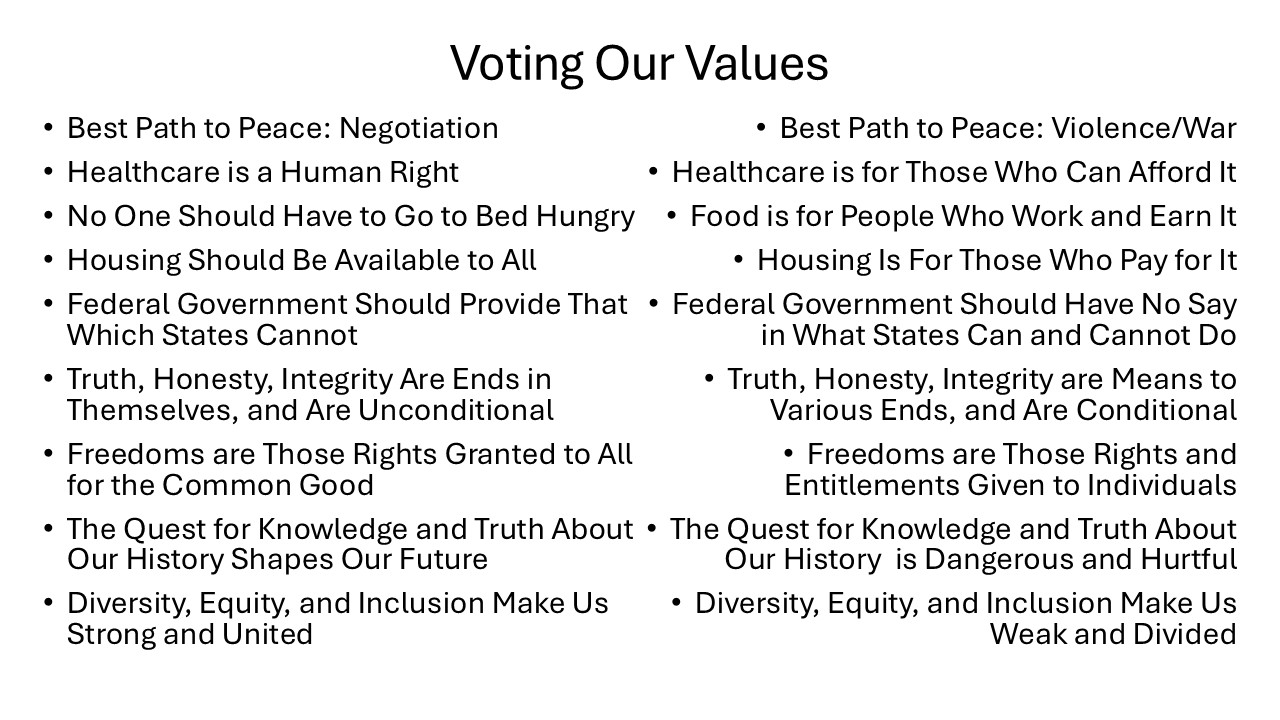
You can see pretty clearly the kinds of legislation, programs, initiatives, political platforms, etc. that might be generated by each. In our current reality, the left hand column reflects the progressive value set and the right hand column reflects a conservative value set. The left tends to be more expansive and inclusive, the right leans more constrained, controlled, and exclusive. The left tends long-term; the right more immediate. We often get dazed and confused by debates over climate, vaccines, corporate practices, class and race distinctions without stepping back to think about underlying values. If the earth is a precious gift given to us by God to tend, care for, and improve, we will view climate change one way. If the earth is a resource freely given to us by God to do with what we please, we may view climate change another way. If science is a gift to us from God, we may trust it more than if we believe science is an opponent and threat to true faith. If we value that all humans are created in the image of God we might approach immigration and racial justice differently than if we believe God intends some to rule, some to toil, and some to fail.
Bottom line, if we believe that life is a gift given to all and that God wants all creation to thrive, we will allow this to be a powerful driver. Equally powerful, however, is the belief that life is what you make it, competition is of more value than collaboration, immediate personal rewards are more important than long-term shared benefits, and that relationships with those you know and like are more important than relationships with those who are different and that you likely will never meet. Who we elect (regardless of what our Electoral College indicates) speaks volumes about the prevailing values of a society and culture. We deserve the leaders we get because of our values. And, sadly, for many values don’t always make much impact. The fact that a statement like “vote your values” is confusing and unclear is evidence of this.
If people don’t understand what values are, doesn’t the Christian church bear some of the blame? Where do we talk about values? Where do we have our values challenged and clarified? Where are we ever asked to compare and prioritize values? It doesn’t happen much in our culture, at all. But it should be happening in faith communities. I am not talking about preaching politics from the pulpit. Heaven forbid (please)! I am talking about looking at the realities we see around our world every day through the lenses of the epic teachings of mercy, compassion, love, justice, humility, grace, kindness, generosity, self-control, gentleness, fidelity, tolerance, acceptance, patience, peace making/building/keeping, security, and yes, empathy (take THAT Elon Musk) that define the faith of those who follow Jesus the Christ.
One reaction that I frequently get is, “well, based on voting my values, there is no one to vote for…” All too often we are faced with the dispiriting and depressing option of voting for the lesser of all evils rather than for the greatest good. This is the sad reality of what we have allowed our politics to become. I would hate that my encouragement to vote our values would result in people deciding not to vote at all. Instead, I hope and pray that voting our values still offers us a way to take steps in a more positive, hopeful, equitable, and just direction for all. All of us are more important than any one of us, and the sooner we realize that we can all benefit together in a time, place, and space of incredible abundance, the sooner we will be able to rest in God’s will and intention for all God’s children.


Leave a Reply