We’ll take anybody. We don’t even require membership classes anymore. Nobody has the time, and most of the people who join our church are coming from other churches, anyway. We ask at the end of every service if there is anyone who wishes to join, they come forward, and we ask if they believe in God and as Jesus Christ as their Lord and Savior. If they say “yes,” they’re in. Our numbers are way up because of it.
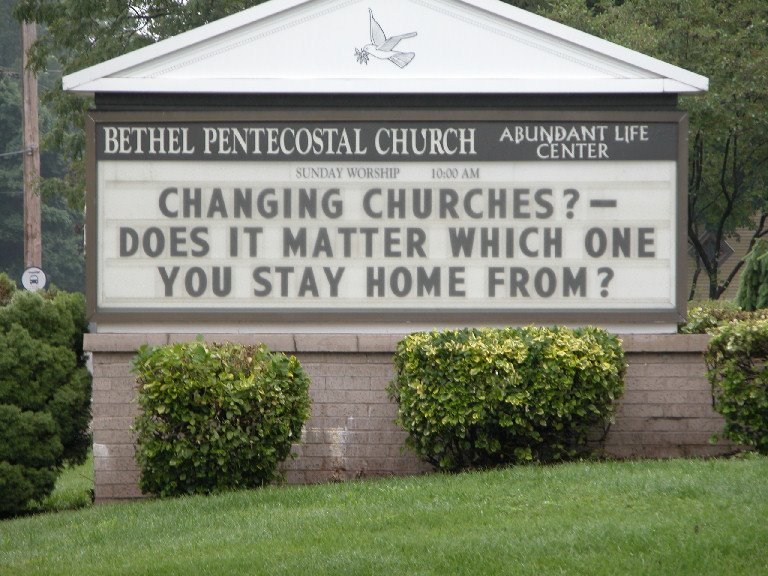 The above paraphrase, comes from a recent conversation I had with one pastor, but it is representative of a large (and possibly growing?) segment of our church. It reflects the “low-cost/high-benefit” mentality of most of American consumer culture, but is it appropriate in the church. I say “no,” but there are an awful lot who say “yes.”
It isn’t about rules and regulations and keeping people out. It is about making it as simple as possible for people to enter the family of God.
This pastor speaks for those who believe no one should be denied, and that church membership is of secondary importance to Christian community. Her comment points out the gatekeeper role of the local congregation and reflects a broad sentiment that any person who wants to say “yes” to Jesus Christ should not only be allowed to do so, but should be helped along in whatever way possible.
I don’t disagree that we should be an open gate — but a gate still implies a boundary; something that distinguishes those who say “yes,” from those who have no interest. For me, there is a huge difference between making something simple and making it meaningless. I believe that many of our attempts to make Christianity simple have done little more than devalue the Christian life, resulting in an insipid, passive, and unproductive faith.
The Christian life has substance. It makes demands. It requires action and practice. It must be learned and honed and perfected. It is a partnership agreement with God, the Holy Spirit, and faith community. It isn’t a hobby. There are very clear requirements and expectations. A person seeking to embark on the lifelong journey of Christian formation needs to know what this means, and then the choice is whether or not the person really, truly wants to pay the costs to reap the benefits. It costs very little to believe in Jesus Christ as the Son of God — you don’t even need a church for that. But to grow in the faith, to perhaps embark on the process of becoming a Christian disciple, to pursue a transformation in the Spirit to lead and teach and serve (whether as laity or clergy) — these require true church. The person seeking doesn’t get to make the “rules.” This would be like hiring someone and telling them their job is to do whatever the heck they want to.
We make a passive, muddled attempt at offering some expectations in The United Methodist Church, but we have little or no accountability, so it all falls flat. We ask newbies if they will “uphold the church by their prayers, presence, gifts, service, and witness,” but offer virtually no guidance as to what we are really asking. We make assumptions that new “members” pray, that they know how to pray, that they have a disciplined prayer life, and that they will now include the “church” in said prayer life. Nine-out-of-ten United Methodists respond to the question, “What does it mean to ‘uphold the church by your presence?’” by answering, “Attend worship services.” Most UMs limit gifts to a financial contribution, service to “helping out at the church,” and witness as “going to church.” The problem here isn’t with people giving poor, low expectation answers. The problem is that leaders in the church offer no challenge to such answers.
Another problem is that the percentage of “new members” who become “inactive members” within the first six months of joining a United Methodist Church crept above the fifty percent line in 2006 and kept going up. New members aren’t even being held to the minimum standards. Zero accountability. A person can “join” a United Methodist Church, never pray, never attend, never give, never serve, never share their faith and remain a member in good standing. What message does this send to the world about the value of membership vows in The United Methodist Church?
We don’t even take members in anymore. People don’t want to join. Anyone is welcome to participate as they feel comfortable. Membership isn’t as important as engagement.
I am in full agreement that membership isn’t the point. Membership has always been a means to an end rather than an end in itself. A membership process at its very best is an integration of a newcomer into the very DNA of the local congregation and the church universal. It is a process of inclusion into the identity and purpose of each congregational entity. It widens the circle we label “us.” It is an organic process of unification and growth. All this changed when the driving value of Methodism shifted from service to size. Once numbers ascended the throne, all bets were off. Getting bodies in the pews trumped getting new members into the body of Christ.
The influx of other faith communions is neither a good thing nor a bad thing, but it does have an impact. The Evangelical Association, The Methodist Church, and the United Brethren (to a lesser extent) were primarily mission societies that prized personal holiness and evangelism above all else. It was clear that “we” existed for one purpose — to be a witness to Christ IN THE WORLD. As we have welcomed Baptists (of all flavors), Presbyterians, Lutherans, Roman Catholics, Episcopalians, Disciples of Christ, and a whole host of other denominations, we have become more stew than salad — a blending of flavors and textures that, over time, lose their distinctiveness and become something “other” (and in our case, I would say, less than the sum of our parts). In a salad, each new veggie or accoutrement adds a flavor or texture, but the whole retains its integrity (kind of like the body of Christ imagery from Paul). We never lose our original intent (becoming greater than the sum of our parts). A significant number of people enter The United Methodist Church dragging their plunder from Egypt — carrying all their history and knowledge of the way their old church worked into their new church. A lay leader in a United Methodist Church said to me recently, “In my last church the priests did everything. I get so angry at our pastor every time he talks about “the ministry of the laity.” If he would spend less time trying to get us to do his work for him, he would get a lot more done!”
When I worked on the Seeker Study for the General Board of Discipleship I talked to literally thousands of 18-31 year old Christians who have no ongoing church affiliation. In conversation after conversation, young people told me that they were frustrated by churches that “couldn’t tell their story.” Many different people said that the reason they didn’t join a church is because they weren’t clear what they would be saying “yes” to. A sampling of their comments indicate that the beliefs, values, practices, expectations and theologies of most local congregations were fuzzy at best. One young woman who claimed to have tried close to 100 different churches put it this way:
If I were looking for a job, I would look for one that matched my skill and knowledge, could help me grow and develop and gain experience, that aligned with my core values and my vision for the work, and I would expect to give my best and in return I would want to be treated fairly. I would need to know what would be expected of me and how I would be evaluated. If I came away from an interview feeling uneasy about my prospective employer, I wouldn’t take the job. When I come away from a church not knowing what it believes, what it has to offer me and what it wants from me, and it doesn’t seem to know what it is there for, I don’t go back.
Accountability to vows before God and a Christian community are not intended to “weed out” anyone, but to facilitate the emergence of those who desire a life in Christ. Accountability is not, by definition, punitive. Actions must have consequences. When people perform well and follow-through on their word, this should be recognized and celebrated. When people perform poorly and fail to keep their vows, there should be consequences. And when people hear what is required and say “no thank you,” then we should honor that, but in no way should we keep lowering our expectations until they are willing to say “yes.” Being a Christian — and more pertinently, being a Christian disciple — comes with some demands. It is up to each and every individual to decide whether or not they want to meet those demands, but this is their choice. The body of Christ needs to be clear that membership in the body means something, and that all are welcome — as long as they are willing to take seriously the promises they make to God and the community of faith.


 FaithQuest Revisited
Leave a reply to Joy Boy Cancel reply